Menu planning · October 25, 2026
One Guest Wants Matcha. Another Wants Coffee. Can One Mobile Bar Do Both?
The invitation list does not divide neatly into coffee people and matcha people. One guest wants an espresso-style drink. Another has been waiting all week for strawberry matcha. The host’s real question is whether offering both creates a better event—or simply a longer line.
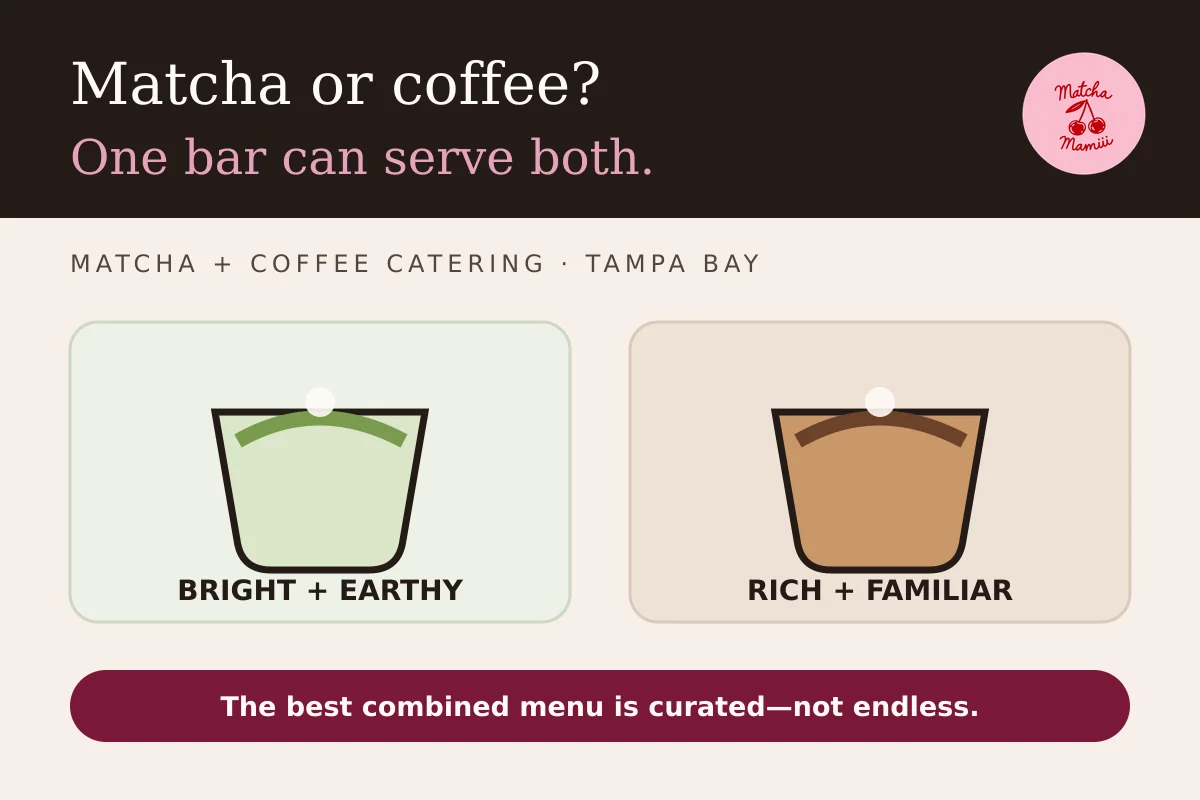
The concise answer: one mobile bar can serve both matcha and coffee at a Tampa event when the menu, equipment and service plan are designed together. A focused combined menu usually welcomes more guests than a single-category bar. The tradeoff is complexity: every additional base, syrup, milk and topping takes space and adds decisions at the counter.
Choice helps only when the line can understand it
A combined bar solves a genuine hospitality problem. Coffee remains familiar to a wide audience, while matcha gives the event a distinctive visual and flavor experience. The latest National Coffee Association survey found that 66% of American adults drank coffee in the past day, with specialty coffee at a record high. That is national data—not a Tampa booking count—but it explains why removing coffee entirely may exclude a large share of a mixed crowd.
Matcha is no longer a niche footnote on major beverage menus either. Starbucks expanded its year-round matcha lineup in February 2026 with fruit- and dessert-inspired drinks. That announcement does not tell us what Tampa guests will order, but it confirms that customers increasingly recognize matcha as a customizable café category rather than one unfamiliar green drink.
The opportunity is not to display every possible option. It is to make both groups feel considered without handing each guest a decision tree.
One bar does not mean two complete cafés
A mobile setup has finite counter space, cold storage, ice, electrical capacity and working hands. Serving matcha and coffee together works best when the two sides share ingredients and the menu avoids unnecessary duplicates.
| Menu decision | What it improves | What it can cost |
|---|---|---|
| Two matcha signatures plus two coffee signatures | Clear variety with a menu guests can scan quickly | More ingredients than a single-category bar, but still manageable |
| Shared milk and syrup choices | Less storage and a more consistent flavor system | Not every customization will be available |
| Separate toppings for every drink | More visual differentiation | More prep, tools, cross-contact questions and slower assembly |
| Open-ended custom ordering | Maximum individual choice | The slowest line and the least predictable product usage |
The most useful comparison is not “four drinks versus eight.” It is how many distinct actions the service team must repeat during the busiest 15 minutes. Our service-capacity guide explains why a short rush matters more than the total event length.
Build the menu around shared ingredients
A strong combined menu often uses one flavor in two different ways. A honey syrup might support a matcha latte and a coffee latte. A fruit component can create a layered matcha while staying off the coffee side. One standard dairy milk and one planned plant-based option may cover the room more efficiently than bringing every carton available at a café.
That does not mean treating the drinks as interchangeable. Matcha needs its own measured preparation, and coffee service has its own equipment and timing. It means designing the ingredient list as one system before loading the vehicle.
Start with the current Matcha Mamiii drink menu, then select a small number of signatures that fit the occasion. The broader event menu guide shows how flavor variety, dietary requests and service speed should be balanced.
When a matcha-only or coffee-only bar is smarter
More choice is not automatically more premium. A single-category bar may be the better fit when the event has a clear theme, a short service window, very high arrival volume or limited power and workspace.
- Choose matcha only when the green drink is part of the visual concept, wellness activation or featured experience.
- Choose coffee only when the audience expects a familiar workplace pick-me-up and speed matters more than novelty.
- Choose both when the crowd is mixed and the service window allows a curated menu to be executed well.
A professional recommendation may narrow the menu after the guest count and venue are known. That is not taking value away. It is protecting the experience the host is paying for.
Ask the venue questions before choosing the drinks
A combined bar can require more counter organization and electrical planning than a simpler setup. Confirm load-in, available outlets, distance from parking, indoor or outdoor placement and the arrival pattern before the final menu is approved. The Tampa venue-requirements checklist covers the practical details.
Dietary requests also need to be handled precisely. Offering oat or almond milk is not the same as promising an allergen-free bar; our dairy-free and allergen-planning guide explains the cross-contact limits.
The better question is what your guests should remember
If the goal is broad familiarity, lead with coffee and add one unmistakable matcha signature. If the goal is a matcha-forward experience, make coffee the quiet alternative rather than half the visual story. For a balanced crowd, give each category two polished choices and let the bar feel intentional.
Request a Matcha Mamiii quote with your Tampa Bay venue, guest count, service window and the split you expect between coffee and matcha drinkers. The recommendation will cover the menu and service plan together—not simply add more drinks to a board.
Current sources: National Coffee Association 2026 Fall National Coffee Data Trends highlights, published September 15, 2026; Starbucks’ February 3, 2026 matcha menu announcement. National consumption and menu signals are context, not Tampa-specific demand estimates.