Interactive events · November 1, 2026
A Matcha Cart Is Not a Matcha Class. Here’s What Changes.
A Tampa-area planner recently asked the question that changes the entire proposal: “Will guests actually make the matcha, or will you make it for them?” Both can feel interactive. Only one turns every table into a working station.
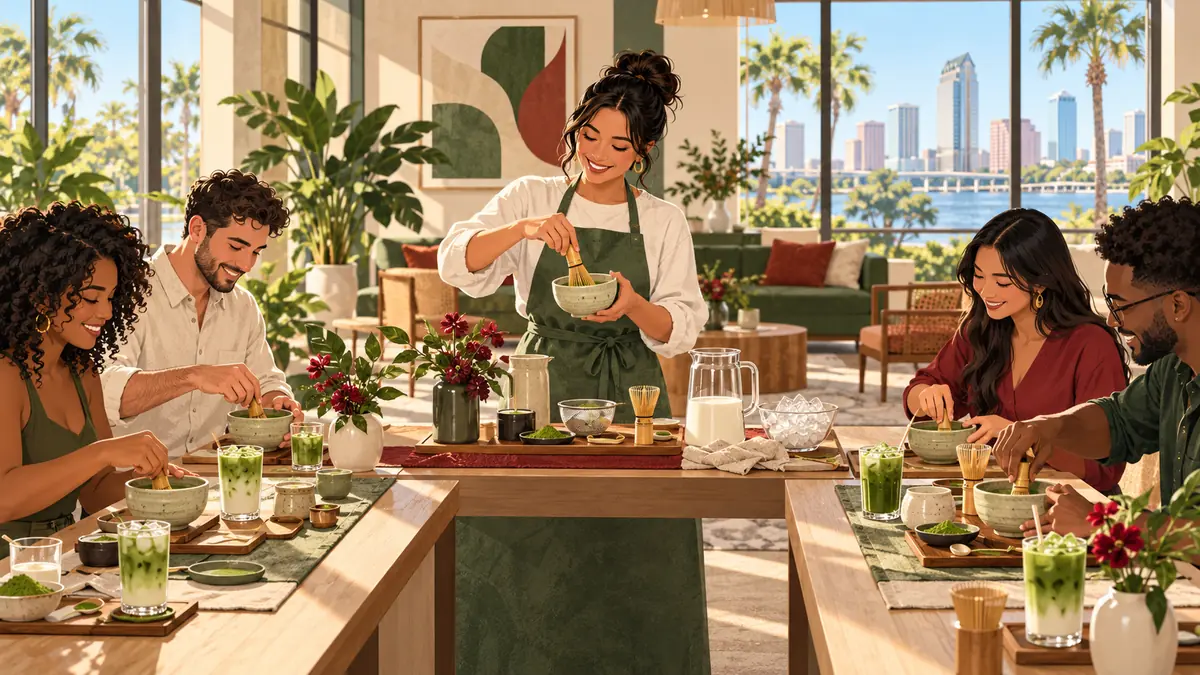
A matcha making class in Tampa is a guided activity in which guests learn some or all of the preparation themselves: measuring, sifting, adding water, whisking and finishing the drink. A mobile matcha cart is staffed beverage service. For 15 guests, either format can fit comfortably into a private event. For 25, a true hands-on class usually needs shared stations, rotations or substantially more equipment. That distinction affects the quote because instruction, bowls, whisks, sanitation, staffing and table space are part of the experience—not free accessories to the drinks.
The important choice is not whether the event is “interactive.” It is how guests participate. Here are the three formats a Tampa host can compare before paying for more equipment or service than the room needs.
Format one: guided demonstration with a build-your-own finish
Best planning range: 15–30 guests · about 60–90 minutes
An instructor shows the group how matcha is measured, sifted and whisked. Guests watch the technique, ask questions, taste the base and personalize the finished drink with a curated choice of milk, sweetness or flavor. Matcha Mamiii can still make the moment participatory without placing a bowl and whisk in every person’s hands.
This is usually the simplest format for an apartment lounge, office wellness hour or social gathering. The group stays together, the host does not need several instruction tables, and the hospitality team can keep service moving while the instructor explains what guests are tasting.
The tradeoff: guests leave understanding the process, but most do not personally complete every step. If “everyone must whisk” is the promise on the invitation, choose a station-based class instead.
Format two: shared-station workshop
Best planning range: 12–25 guests · about 90–120 minutes
Small groups rotate through defined roles. One person measures, another sifts, another adds water, another whisks and the group finishes or tastes the drink together. The next round changes roles. A station may need a tray, bowl, whisk, sifter, measuring tools, towel, waste vessel and a controlled hot-water plan before milk, sweetener, ice and cups even enter the picture.
Shared stations are the strongest middle ground for a 15-person event. They create real participation without buying 15 complete tool sets. At 25 guests, the host should expect either more stations, multiple rounds or an additional team member to reset tools and keep instruction consistent.
The tradeoff: this format requires more room, coordination and cleanup than a demonstration. A two-hour invitation does not automatically mean two hours of nonstop whisking; orientation, demonstration, rotations, tasting and resetting all need time.
Format three: individual hands-on class
Best planning range: 8–15 guests · about 90–120 minutes
Every participant receives a dedicated bowl, whisk, sifter and measuring setup for the active lesson. The instructor can correct grip and whisking motion while each person prepares a bowl. A printed recipe, takeaway matcha or personal whisk can turn the class into a premium gift experience.
This is the most personal format and the most equipment-heavy. It also needs the largest clean, seated work surface per guest. If the venue expects 25 people, an individual setup can still be designed, but the proposal must account for purchasing or renting enough tools, transporting them safely and washing or packing every piece after service.
The tradeoff: the ticket or hosted price rises because each participant receives dedicated materials and more instructor attention. The price is not simply 15 drinks multiplied by a menu price.
The equipment is part of the product
A private class should state how many guests work at once and what each station receives. “Interactive” is too vague to price responsibly. At minimum, the host should be able to see whether the plan includes:
- matcha, measured water and the selected milk, sweetener or flavor;
- bowls, whisks, sifters, spoons and station trays;
- safe hot-water service and a clearly controlled work area;
- cups, ice, napkins, towels and waste collection;
- instruction, station resets, load-in, setup and cleanup;
- printed guidance or take-home tools, when included as an add-on.
Ippodo’s published basic usucha method uses 2 grams of matcha, 60 milliliters of water at 80°C and about 15 seconds of whisking. That is a useful teaching reference, but an iced latte workshop adds milk, sweetener, ice, service vessels and another sequence of steps. The recipe and the event format should be designed together, not copied from a single café drink.
Whisks are also working tools, not decorations. Ippodo advises keeping them clean, and its bamboo-whisk guidance notes that a whisk used for ingredients such as milk can retain odor. A class plan therefore needs separate finishing tools or a workflow that keeps the chasen in the matcha-and-water stage.
A modern workshop is not automatically a tea ceremony
Matcha has cultural depth, and the language matters. Urasenke describes chado—the Way of Tea—as a spiritual and aesthetic discipline centered on host and guest sharing a bowl of matcha. That is broader and more exacting than a contemporary latte workshop.
Matcha Mamiii can teach an approachable preparation method, explain the role of the bowl and whisk, and treat the tea with respect. We should not market a modern event as a “Japanese tea ceremony” unless it is genuinely designed and led within that tradition. “Interactive matcha workshop,” “guided matcha class” and “matcha tasting” are clearer promises.
Allergens belong in the class plan
The FDA identifies milk and certain tree nuts among the major food allergens. A workshop serving whole milk, almond milk, cookie butter or flavored syrups needs ingredient information and an honest cross-contact notice before guests begin sharing tools.
A dairy-free choice does not make the entire mobile environment allergen-free. For a group with serious allergies, the host should collect needs early and review the Matcha Mamiii dairy-free and cross-contact guide. The safest answer may be a simplified menu, individually identified ingredients or declining a customization that cannot be served responsibly.
What current Tampa workshops tell us
Interactive matcha is no longer an imaginary event category. One current public Tampa workshop advertises a 60-minute class for $35 per seat that includes participant whisking and a take-home 20-gram bag of matcha. That is a useful market reference—not a direct comparison with a private hosted class.
A private class brings the instructor, mobile setup and equipment to the host’s venue; blocks a date; manages load-in and cleanup; and may be customized for one group. The quote should reflect those costs. “Exposure” or a drink count does not replace the labor and materials required to turn a lounge into a classroom.
How to choose without overbuying
| If the host wants… | Choose… | Ask before booking |
|---|---|---|
| A social activity with smooth service | Guided demonstration | What will guests personally choose or finish? |
| Everyone involved without one full set per person | Shared stations | How many guests work at once, and how are tools reset? |
| A premium skill-building experience | Individual hands-on class | Are tools shared, borrowed or taken home? |
For 15 guests, the shared-station format often creates the best balance of participation and price. For 25, a polished demonstration or rotating workshop can be easier to understand and execute than promising an individual tool set that the venue, schedule or budget does not support. These are planning ranges, not guaranteed capacities; the room, menu and staffing still decide the final format.
What to send for an accurate class quote
Include the date, venue, guest count, desired duration and indoor or outdoor setting. Then answer one sentence: Does every guest need to whisk, or does every guest need to participate? That answer prevents the most expensive misunderstanding.
Review what the standard mobile matcha bar includes, compare hosted package starting points, explore apartment and resident experiences, or request an interactive class proposal. Matcha Mamiii will confirm the format, station count, included equipment and guest experience in writing before a deposit holds the date.
Preparation details were checked November 1, 2026 against Ippodo Tea, Urasenke and current FDA allergen guidance. The Tampa workshop example was checked against the provider’s public listing on the same date. Event ranges in this article are Matcha Mamiii planning guidance, not capacity guarantees or a representation of a completed private class.